What to Expect at a Residential Hospice: A Family Guide
When the Anderson family first walked into Our Lady of Peace, they expected sterile hallways. Instead, they found a sunlit room, a quilt on the bed, and a nurse who already knew their mother’s name. “It felt like walking into someone’s home,” Margaret Anderson’s daughter later recalled. “Not a hospital. A home.”
That experience — the relief of finding comfort where you expected clinical coldness — is what draws thousands of families to hospice homes each year. A hospice home, also called a residential hospice facility, is a dedicated, home-like setting where patients with a terminal illness receive 24-hour comfort care from a specialized hospice team. Unlike hospitals or nursing homes, residential hospices are designed to feel like home while providing the clinical support families cannot manage on their own.
If you are exploring hospice homes for a parent, spouse, or loved one, this guide walks you through what residential hospice care actually looks like — from your first visit to daily routines — so you can make an informed, confident decision for your family.
What Are Hospice Homes? Understanding Residential Hospice Care
Hospice homes are freestanding or dedicated residential facilities where patients live full-time while receiving end-of-life comfort care. The goal is not to treat illness but to ensure the highest possible quality of life through expert symptom management, emotional support, and dignified companionship.
How Hospice Homes Differ from Hospitals and Nursing Homes
The differences matter more than most families realize:
- Hospitals focus on acute treatment and stabilization. Rooms may be shared, schedules are rigid, and the environment is clinical.
- Nursing homes provide long-term custodial and skilled nursing care, often for patients with varying conditions. They are not specifically designed for end-of-life comfort.
- Hospice homes are built around one purpose: providing compassionate comfort care in a peaceful, home-like setting. Every design choice — from private rooms to family gathering spaces — serves the patient’s comfort and the family’s need for closeness.
Who Is Eligible for a Residential Hospice Home?
Hospice care is available to individuals with a life-limiting illness and an estimated prognosis of six months or less, as determined by a physician. Qualifying conditions include cancer, heart failure, COPD, dementia, ALS, and other terminal diagnoses.
When a loved one is diagnosed with a life-limiting illness of six months or less, finding the right care can feel overwhelming. While many choose to receive hospice care at home, there are times when a patient’s medical needs require 24/7 skilled nursing that simply can’t be safely managed at home. That’s where residential hospice becomes an invaluable option.
However, navigating the costs of residential hospice often surprises families. Under standard Medicare rules, insurance typically only covers the cost of clinical care—leaving patients and their families to pay an out-of-pocket room-and-board fee that often exceeds $400 a day.
At Our Lady of Peace, we believe financial stress shouldn’t stand in the way of dignified, compassionate care.
Unlike many other facilities, Our Lady of Peace only accepts what your insurance benefit pays. We never charge our patients a copay or a daily room rate. Thanks to the incredible generosity of our community donors, expert around-the-clock hospice care remains accessible to those who need it most—without the burden of overwhelming medical bills.
What Daily Life Looks Like in a Residential Hospice
One of the most common questions families ask is simply: “What will my mom’s day look like?” The answer often surprises them. Daily life in a hospice home is structured around the patient — not around institutional schedules.
Morning Routines Built Around the Patient
There is no 6:00 a.m. wake-up call. Patients rise when they are ready. A nurse checks in to manage any symptoms — adjusting medication, repositioning for comfort, or simply sitting and talking. Breakfast comes when the patient is hungry, not when the kitchen is open.
Visits, Activities, and Quiet Time
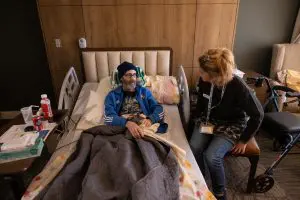
Families are welcome at any hour. Many hospice homes have gathering spaces — a shared kitchenette, a garden, a living room — where loved ones can sit together outside the patient’s room. Chaplains, social workers, music therapists, pet therapy dogs and volunteers visit throughout the week.
Some days are full of visitors and conversation. Others are quiet, with a patient resting while a family member reads nearby. Both are normal. Both are honored.

Around-the-Clock Care Without the Clinical Feel
Registered nurses and certified nursing assistants are present 24 hours a day, 7 days a week. Pain management is proactive — the care team monitors symptoms continuously rather than waiting for a patient to press a call button. If a patient’s needs change at 2:00 a.m., the team is already there.
The difference families notice most is the pace. Staff can sit down. They listen. They know your loved one’s story.
When Is a Hospice Home the Right Choice Over In-Home Care?
Many families begin with in-home hospice care, where a care team visits the patient in their own home on a scheduled basis. In-home hospice works beautifully for many families — but there are moments when residential hospice care becomes the better path.
Signs That Residential Care May Be Needed
Consider a hospice home when:
- Symptom management requires 24-hour nursing. Some conditions — uncontrolled pain, breathing difficulty, severe agitation — need continuous professional monitoring that periodic home visits cannot provide.
- Family caregivers are physically or emotionally exhausted. Caregiver burnout is real and common. Choosing residential hospice is not giving up — it is ensuring your loved one gets expert care while you get the rest you need to be fully present.
- The home environment is no longer safe. Narrow hallways, stairs, or a lack of accessible bathrooms can make home-based care difficult or dangerous as a patient’s mobility declines.
- The patient lives alone. Without a full-time caregiver in the home, gaps between scheduled hospice visits can leave a patient vulnerable
An Important Consideration: Your Care Team
It is always worth asking if a patient can keep their primary care physician. While some hospice providers accommodate existing doctors, Our Lady of Peace Hospice Residence requires working directly with our specialized medical team. Having dedicated, in-house physicians ensures smooth, round-the-clock care—an important factor to keep in mind when exploring your options.
What OLP’s 21-Room Residential Hospice Offers Families
Our Lady of Peace has provided hospice care in St. Paul, Minnesota since 1941. The 21-private-room residential hospice is one of the organization’s most distinctive offerings — and one of the rarest in the region.
Fewer than 10% of hospice providers in the United States operate a residential facility — most offer only in-home services. Our Lady of Peace’s 21-room residence in St. Paul is one of the few such facilities in the Twin Cities.
— NHPCO facility data
A Home, Not a Hospital
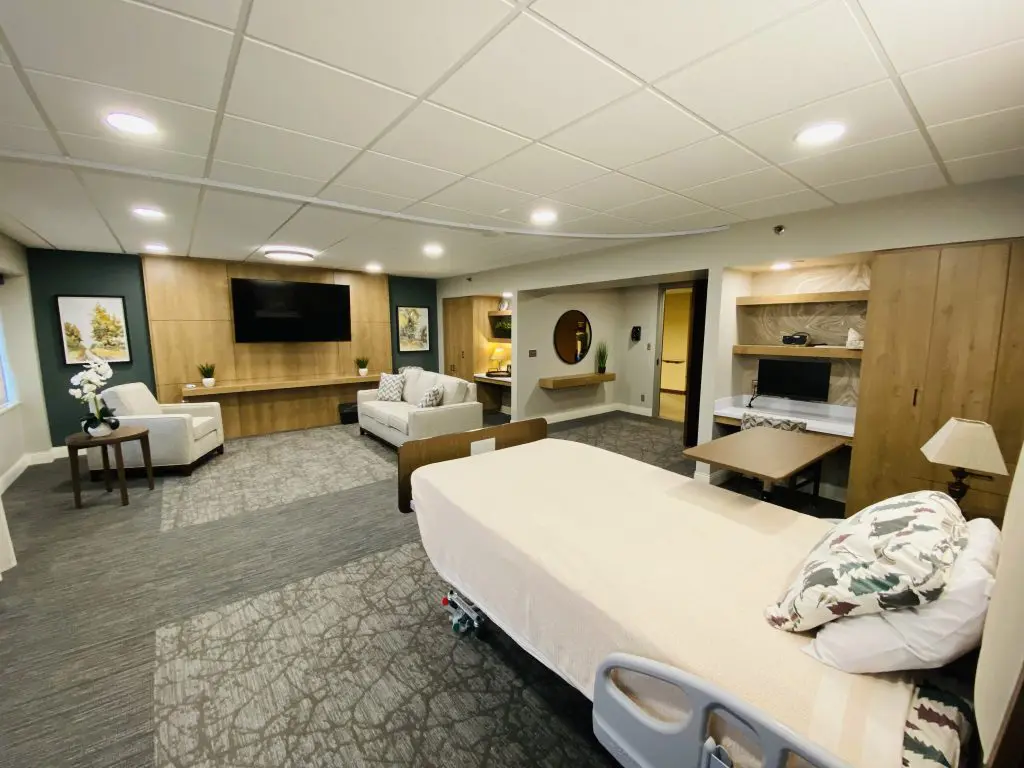
Every room at Our Lady of Peace is private. Families can bring personal items — photographs, a favorite blanket, a small music player — to make the space feel like their loved one’s own. The residence features beautiful spacious rooms, shared common areas, and several outdoor garden spaces.
The care team includes registered nurses, certified nursing assistants, chaplains, social workers, and trained volunteers — all focused exclusively on comfort care. The staff-to-patient ratio allows for the kind of unhurried, personal attention that larger facilities simply cannot provide.
Residential Hospice Care Near the Twin Cities
Located in St. Paul, Our Lady of Peace (OLP) provides expert residential hospice care to families across Minneapolis and the greater Twin Cities area. We combine a convenient, accessible location with compassionate support. To make our residents as comfortable as possible, we also offer soothing spa baths alongside complimentary music, massage, and pet therapy.
Faith-Inspired, All Faiths Welcome
Our Lady of Peace was founded in the Catholic tradition of compassionate care on December 7, 1941. That heritage shapes everything — from the dignity with which each patient is treated to the spiritual support available through chaplaincy services. Families of all faiths, and those with no religious affiliation, are equally welcomed and respected.
How to Arrange a Visit or Tour
Seeing a hospice home in person is the single best way to understand whether it is right for your family. A tour removes the uncertainty and replaces it with something concrete: the feeling of the space, the warmth of the staff, and the peace that comes from knowing your loved one will be cared for.
Step 1: Call the Admissions Team
Reach Our Lady of Peace at 651-789-5031. The admissions team can answer your initial questions, discuss your loved one’s specific needs, and schedule a visit at a time that works for your family. Referrals can come from healthcare professionals, family members, or patients themselves — though admission to any service does require a provider order.
Step 2: Tour the Residence
During a tour, you will see the private patient rooms, common areas, gardens, and support spaces. Staff will walk you through what a typical day looks like and answer questions about care plans, visiting hours, and what personal items families can bring.
If you cannot visit in person right away, watch a video tour of Our Lady of Peace’s residential hospice to get a sense of the environment from home.
Step 3: Discuss Insurance and Eligibility
The admissions team will help you understand what Medicare, Medicaid, or your private insurance covers. They will also coordinate with your loved one’s physician to confirm hospice eligibility and begin the care planning process.
You do not need to have all the answers before calling. That is what the team is there for.
Frequently Asked Questions About Residential Hospice
What is the difference between a hospice home and a nursing home?
A hospice home is specifically designed for end-of-life comfort care — every aspect of the environment and staffing is focused on symptom management, emotional support, and dignity. Nursing homes provide long-term custodial or skilled nursing care for patients with a wide range of conditions and goals, including rehabilitation and ongoing medical treatment.
Does Medicare cover residential hospice care?
Yes. Medicare covers standard hospice services—including 24/7 nursing care, medical equipment, medications, and support services.
While routine residential room and board often comes with out-of-pocket costs elsewhere, our patients never receive a bill. Thanks to generous community donors, Our Lady of Peace has provided 100% fully covered care since December 7, 1941.
Can family members stay overnight at a hospice home?
At Our Lady of Peace, families are welcome around the clock. Loved ones can stay overnight at the bedside, and the residence provides spaces where family members can rest, gather, or share a meal together. There are no restricted visiting hours.
How long can a patient stay in a residential hospice?
There is no predetermined time limit for care. Because Our Lady of Peace provides acute support for patients needing intensive help with daily living, stays are often 6 weeks or less. However, stays are based on medical need, not a clock. As long as a physician certifies that a patient meets hospice criteria, they are never asked to leave. Our care team continuously reassesses each resident and keeps families fully updated on their care plan.
How do I arrange a tour of OLP’s residential hospice?
Call Our Lady of Peace at 651-789-5031 to schedule a tour. You can also visit the residential hospice page to learn more about the facility, or watch a video tour online before visiting in person. The admissions team welcomes inquiries from families, patients, and healthcare professionals.
Choosing a hospice home for someone you love is one of the most meaningful decisions a family can make. It is not a last resort — it is a gift of comfort, dignity, and presence during the time that matters most.
If you are considering residential hospice care for a loved one, we are here to help you take the next step.
Schedule a tour of our residential hospice — call 651-789-5031 or visit our residential hospice page to learn more.
Prefer to start from home? Watch a video tour of Our Lady of Peace’s residence and see the space for yourself.